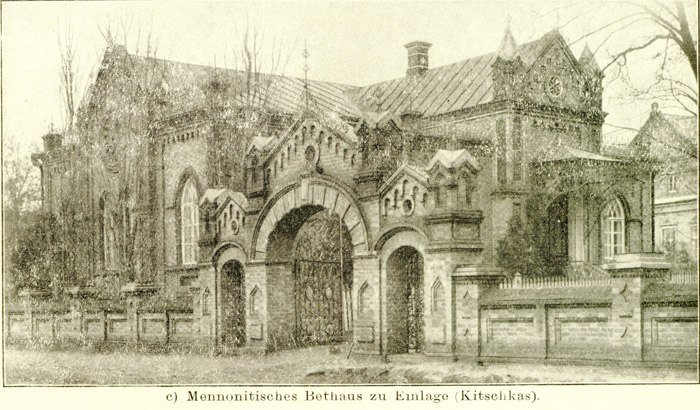
The colony of Einlage, founded in 1790 on the right bank of the Dnipro by Flemish settlers from West Prussia, was one of the oldest and largest Mennonite colonies in Ukraine. It inherited its name from a settlement on the Nogat River (now the village of Jazowa in northern Poland). By 1914, the population of Einlage had reached 1,500 people, and the town itself had become a powerful economic centre. Farming, industry, and trade flourished here: the agricultural machinery plants of H. Unger and J. Friesen operated, as did the large mills of H. Unger and K. Marten, along with numerous smaller enterprises — from sawmills to carpentry workshops. A powerful impetus for this rapid development came with the laying of the Second Catherine Railway through Einlage at the beginning of the 20th century.
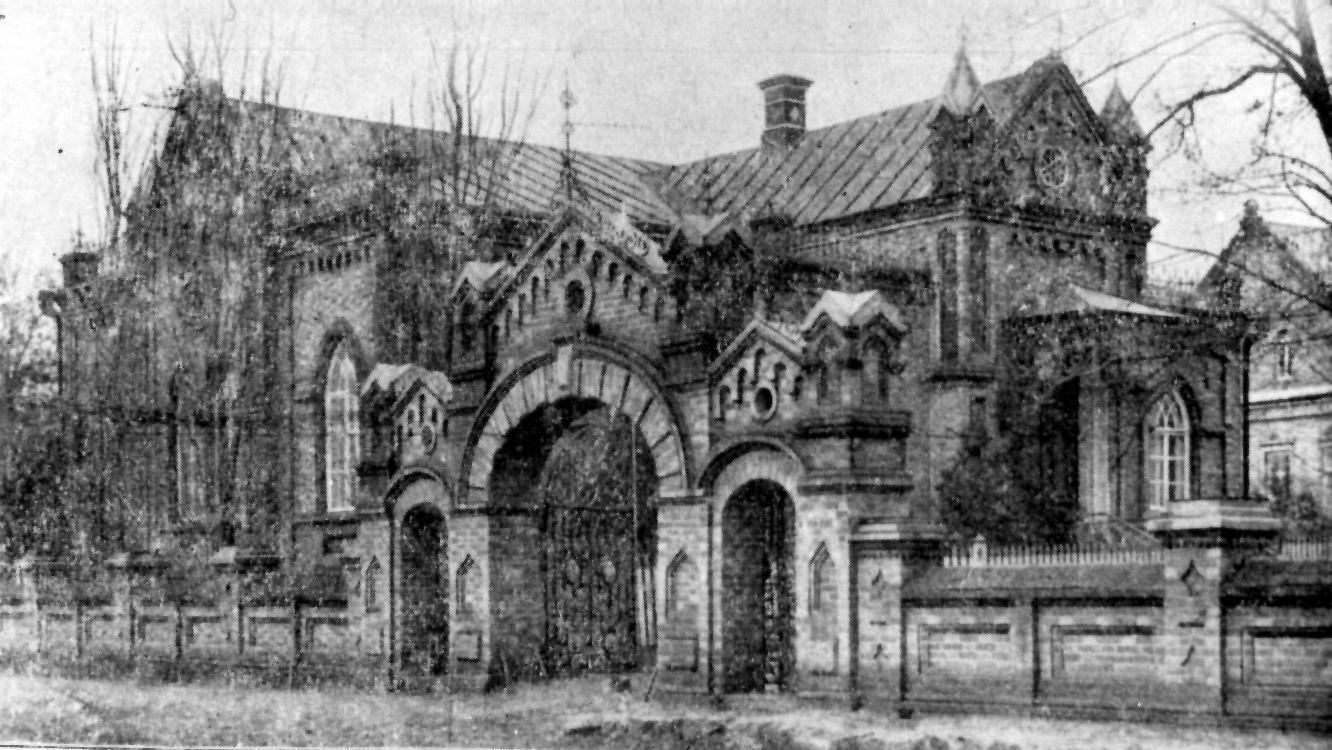
It was on the wave of this economic rise that the settlement’s main adornment appeared — the Einlage Mennonite Church. Before its construction, religious services were held in an ordinary village school. The building works, overseen by Peter Reimer, Jakob Friese, and Abraham Unger, were completed on 27 December 1900 at a cost of 17,000 roubles. The church was designed in the Neo-Gothic style, with large pointed windows and stone rosettes on the façades characteristic of Western European cathedrals. Among researchers there exists a hypothesis that the architectural design was borrowed from the Mennonite church of the village of Heubuden (now Stogi near Malbork in Poland), however archival photographs from the early 20th century do not confirm this.
From the street, the church courtyard was enclosed by a high brick wall with ornately decorated gates. The interior space of the church, which could accommodate up to 400 worshippers, remained traditional for Mennonite architecture: it was an elongated rectangular sanctuary measuring 12 by 24 metres. Along the long outer wall, a raised pulpit for sermons stood prominently, while opposite it was a balcony housing a harmonium — an instrument that resembles a piano in appearance but sounds like an organ.
In the interest of maintaining modesty, order, and maximum concentration on prayer, the space was strictly segregated — men and women used separate entrances. Adjacent to the men’s entrance, a room was set up for the choir soloists, which had a direct exit to the sanctuary.
The history of this magnificent structure proved to be brief. In 1927–1932, during the construction of the Dnipro Hydroelectric Power Station, the colony of Einlage fell within the future flood zone, and the church building was dismantled permanently.